Readers are usually chosen in the wrong order. Buyers compare models first, then discover that the dock door needs four antenna ports and a PoE run, that the sales floor cannot carry cable to the ceiling, or that the handheld cannot stay charged across an eight-hour shift.
Start from the read point instead. A read point is a physical place where tags must be captured: a dock door, a conveyor tunnel, a shelf, a tray at a counter, a vehicle gate. Each read point has a required read zone, a traffic pattern and a set of installation constraints. Those three facts select the reader.
The four form factors and what they are actually for
- Fixed reader with external antennas. Best for defined portals, tunnels, production lines and conveyor reads. Continuous power, multiple antenna ports, high duty cycle, centralised management. Requires cabling, mounting and antenna planning.
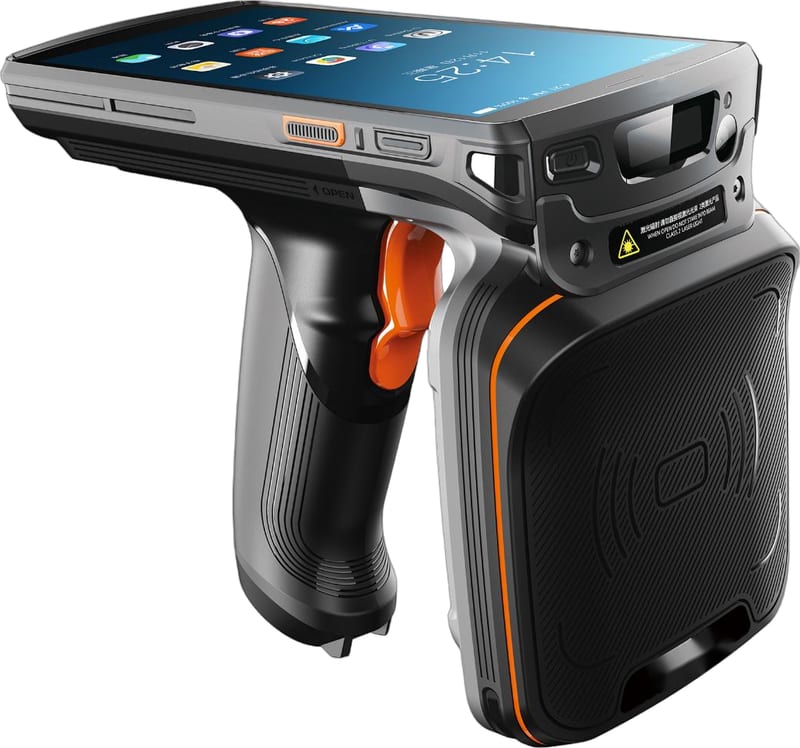
- Handheld reader. Best for mobile tasks: shelf-level stocktaking, exception finding, receiving checks, field asset audits. Its advantage is that a person can bring the read point to the item. Its limits are battery, ergonomics and read consistency across operators.
- Overhead / ceiling reader. Best for open sales floors and storage areas where cable cannot reach every shelf and where continuous background counting is wanted. Coverage is wide, precision is lower, and mounting height drives antenna choice.
- Integrated gate or tunnel. Best for high-volume, hands-free reads: apparel store exits, library security, pallet portals, baggage handling. It is a productised combination of reader, antennas, sensors and alarm logic rather than a bare reader.
A common mistake is to use a fixed reader where a handheld belongs, or the reverse. A fixed reader cannot find one missing carton in a back room; a handheld cannot count 3,000 items per hour on a conveyor.
Dimension 1: read zone, not "read distance"
Datasheet range is measured under ideal conditions with a single tag in free space. The number that matters is the size of the zone where your tags, on your products, are read reliably:
- Dock doors and portals: 3–6 m wide, 2–3 m high, with tags on moving forklifts. Overlap between adjacent doors is the main design problem.
- Conveyor tunnels: 0.8–1.2 m, high speed, dense tag populations. Requires shielding and precise antenna aiming.
- Shelf and sales floor: 3–8 m radius per overhead reader, dependent on ceiling height and fixture density.
- Counter / tray: 10–30 cm, deliberately small so neighbouring items are not read.
Specify the zone as a volume with a required read rate, for example "99% of cartons passing a 2.5 m × 2 m × 2 m portal at 1.5 m/s". Then test it.
Dimension 2: interference and read discipline
UHF is shared spectrum. Real sites contain neighbouring readers, Wi-Fi, metal reflections and moving people:
- Adjacent-portal interference is solved with synchronisation, shielding, power reduction and antenna orientation — not by turning power up.
- Dense-reader environments need a reader that supports dense-reader mode and per-antenna power control.
- Reflections off metal racking create dead spots and phantom reads at the edge of the zone; a site survey with the real racking is the only reliable fix.
- Handheld reads are the least controlled; expect a 2–5% variation between operators unless the workflow enforces a fixed sweep pattern.
Judge a reader by its ability to hold a stable read rate in a crowded radio environment, not by its maximum output power.
Dimension 3: ports, power and interfaces
- Antenna ports: one port is enough for a counter or a single-lane tunnel; four ports cover a two-sided portal with redundancy; eight ports are for large tunnels and multi-lane gates. Ports are cheaper than later re-cabling.
- Power: PoE+ simplifies ceiling and portal installation and removes local power supplies; check the power budget at maximum output.
- Interfaces: Ethernet for fixed infrastructure, RS-232/485 for legacy PLCs, GPIO for sensors, lights and alarms that must work without the ERP being online.
- Edge behaviour: a reader that can buffer events and apply a local filter survives a network drop; one that streams raw reads to a server does not.
Dimension 4: installation reality
The best reader fails if it cannot be installed:
- Cable path: ceiling readers need a route to the ceiling void; heritage or glass-fronted stores often have none.
- Mounting height: overhead readers at 4–6 m need narrow-beam antennas and careful aiming; at 3 m, wider coverage is acceptable.
- Environment: washdown areas, cold stores and outdoor yards need IP-rated housings and sealed connectors, not an indoor unit in a box.
- Safety and aesthetics: portals in customer-facing areas need integration with fixturing, not a bracket on a wall.
Dimension 5: integration with Odoo and the WMS
Reader choice constrains integration more than buyers expect:
- Fixed readers normally expose LLRP or a vendor SDK; middleware converts reads into business events.
- Handhelds usually run an Android app that posts to an API; offline buffering and duplicate suppression are essential because the device will lose Wi-Fi.
- Overhead readers produce continuous, repetitive reads: the middleware must aggregate and de-duplicate before anything reaches Odoo, or the ERP will receive thousands of meaningless stock moves.
- Integrated gates add alarm and direction logic that must map to a business exception, not a raw read.
Ask one question of every candidate: what is the supported, documented path from this device to an Odoo inventory adjustment, and who owns each hop? A reader without a proven integration path is a prototype.
Dimension 6: lifecycle and serviceability
- Firmware and security updates: an unpatched reader on the corporate network is a liability.
- Spare parts and second source: a five-year deployment outlives most product cycles.
- Remote management: configuration drift across 40 readers is a real operational cost.
- Diagnostics: per-antenna read counts, temperature, uptime and reconnection counters turn "it feels slow" into a measurable ticket.
A practical selection sequence
1. Draw the read points on the floor plan and write the required zone and read rate for each. 2. Choose the form factor per read point, not per site. 3. Run a two-week test at the hardest read point with real tags and real traffic. 4. Only then compare models on ports, power, interfaces and integration path. 5. Buy one spare per 20 devices and standardise on a single firmware branch.
Readers are the most visible cost line in an RFID project and the least important long-term decision. The read point design, the antenna placement and the middleware discipline decide whether the system works; the reader model mostly decides how much maintenance it needs.