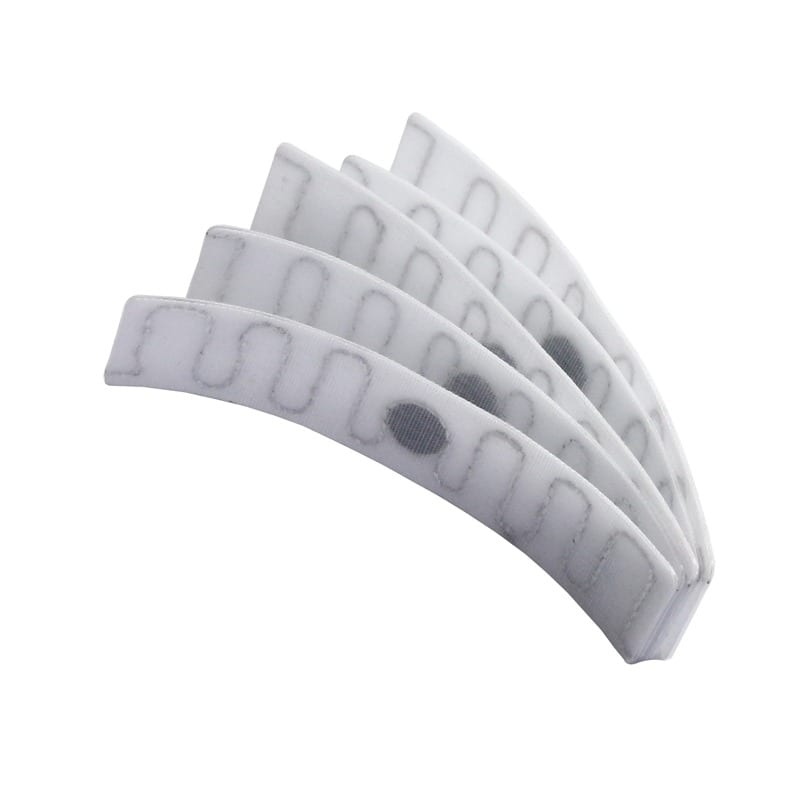
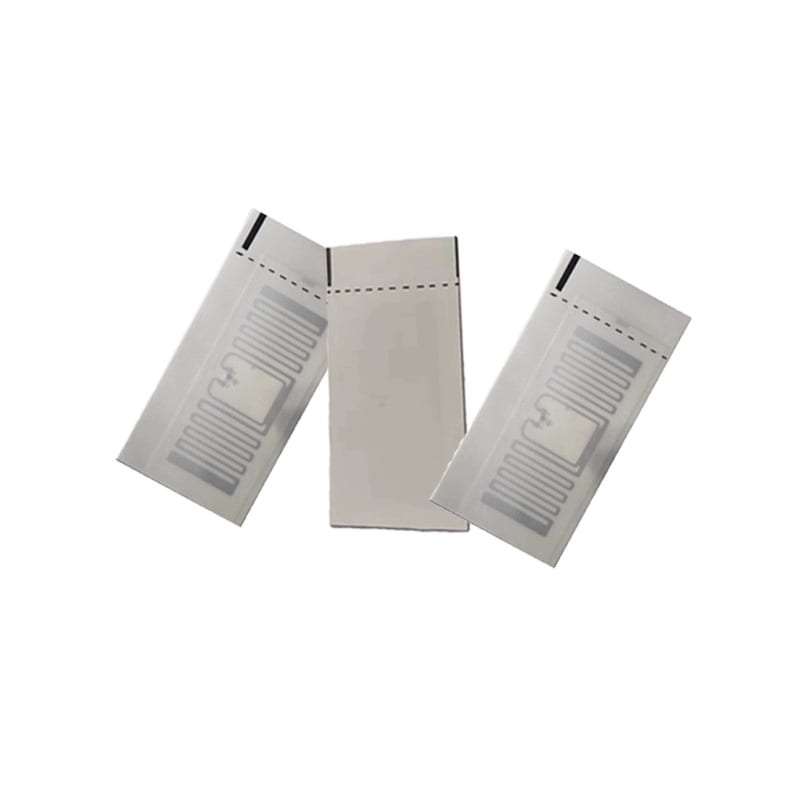
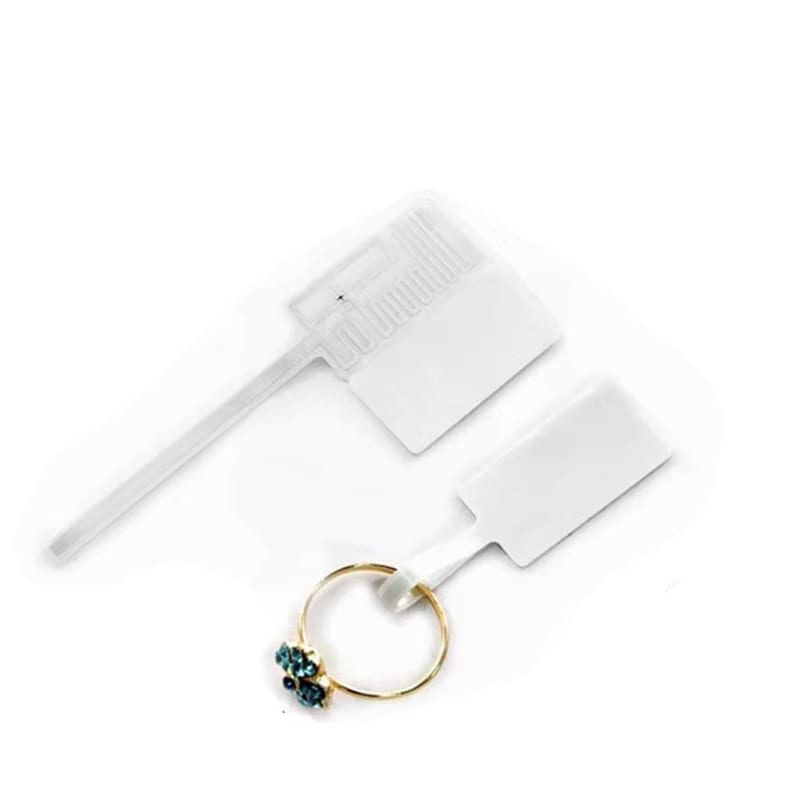
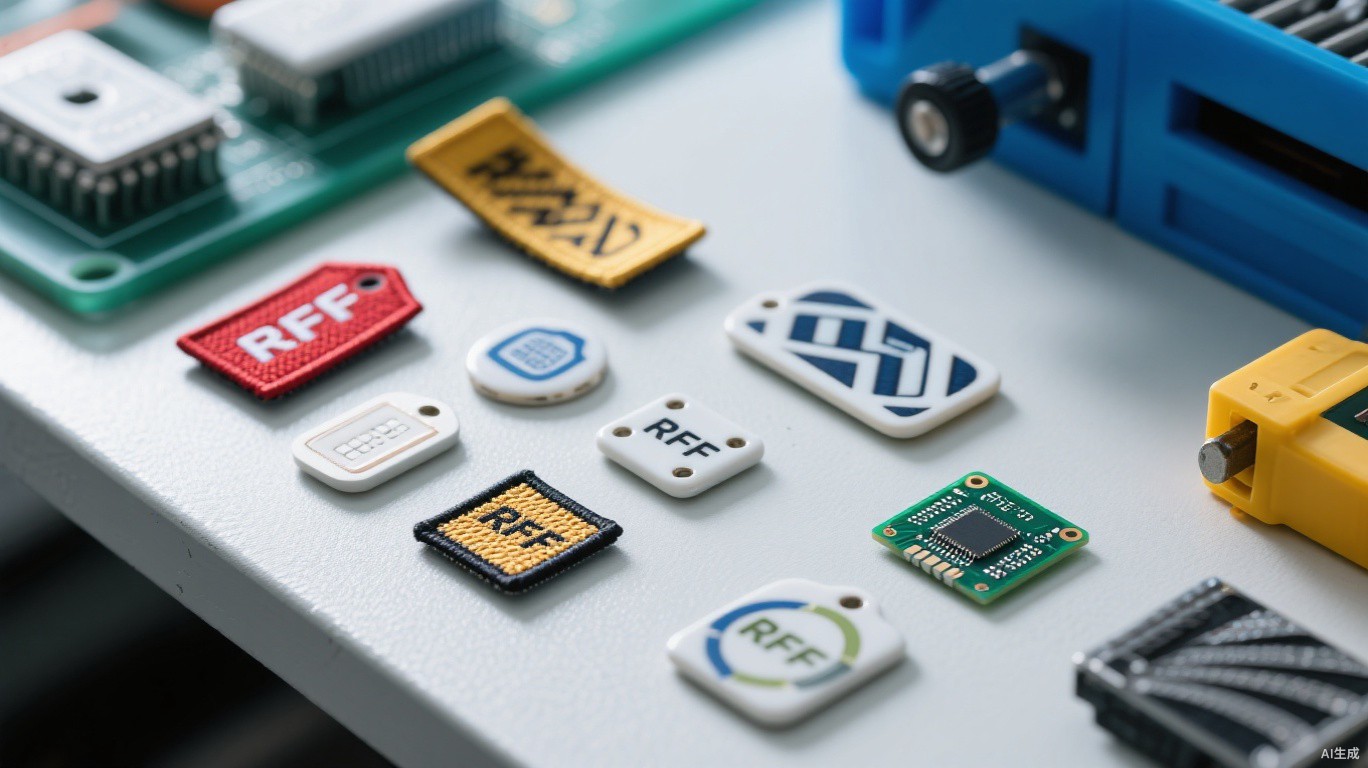
Every RFID tag works when it is new. The question that decides whether a project succeeds is what happens at cycle 400, after two summers, after a hundred wash cycles, after a winter of salt on the loading dock. Durability is not a datasheet number. It is a distribution of failure times, and the only way to know it is to break samples on purpose and record how they broke.
Failure is a lifecycle problem, not a defect problem
Most tag failures in the field are not manufacturing defects. They are the predictable consequence of an environment the tag was never designed for.
- The inlay antenna is a thin aluminium or copper pattern. Every flex, every thermal expansion and every chemical attack works on that pattern.
- The adhesive is usually the first thing to fail, and a tag that has lifted at one corner loses read range long before it falls off.
- The chip interconnect is the second. Thermomechanical stress cracks the bond, and the tag becomes intermittent rather than dead — the worst failure mode, because it hides.
- The face material protects the inlay, but only against the threat it was chosen for. A resin that resists water may not resist UV.
- Intermittent failures are far more damaging than clean failures, because they generate exceptions that look like reader problems and consume engineering time for months.
Thermal cycling: the test most projects skip
Temperature is the most common cause of field failure and the least commonly tested properly.
- Test the full range the tag will actually see, plus margin: for a pallet tag in an unheated warehouse, minus 20 to plus 55 degrees Celsius is a realistic envelope.
- Test the transitions, not just the extremes. A tag that survives a week at 60 degrees may fail after 200 cycles between minus 20 and plus 60, because the failure mechanism is differential expansion, not absolute heat.
- Dwell long enough for the tag to reach temperature. A two-minute soak in a chamber does not heat a palletised carton.
- Include humidity. Condensation forming inside a label during a rapid transition is a common and invisible failure path.
- Record read range before, during and after each block of cycles. A tag that still reads but has lost half its range has failed, even if it passes a go/no-go test.
- Automotive and cold-chain applications need their own profiles: paint ovens, freezer rooms, blast chillers.
A typical acceptance criterion is no more than 1 % read-range degradation after 100 cycles across the specified envelope, on a sample of at least 30 tags.
Salt spray, humidity and corrosion
Salt is the most under-tested threat in logistics, because most RFID projects are specified indoors and deployed near a coast.
- Salt spray attacks the antenna pattern directly wherever the face material is porous or damaged.
- The failure appears as a gradual range loss over months, which is invisible in commissioning and obvious in year two.
- Test to the standard your industry uses — neutral salt spray at 35 degrees Celsius for a defined number of hours — and state the hours, not just "passed".
- Condensing humidity is a separate test. A tag that survives salt fog may still fail in a chilled distribution centre where condensation forms every night.
- Check the adhesive under humidity specifically. Many adhesives lose tack at high humidity and recover when dry, producing a seasonal read-rate pattern nobody investigates.
- If the deployment is coastal or refrigerated, specify a tag with encapsulated inlay and a tested adhesive, and accept the cost.
Vibration, drop and torsion
Handling damage is mechanical, and mechanical damage is cumulative.
- Vibration on a conveyor or in a truck is not a single impact. It is millions of small flexes, and it delaminates inlays at the edges first.
- Test at the frequency and amplitude of the real installation, on the real packaging. A tag on a steel pallet in a vibrating truck is a different test from a tag on a carton.
- Drop tests should be run on the packaged item, not on the tag alone, and from the height the item actually falls.
- Torsion matters for tags on flexible substrates: a polybag tag that survives drop will still fail at the crease where the bag is folded.
- Inspect after each block, not only at the end. The intermediate inspection tells you which mechanism is dominant, and that is the information you need to change the design.
- Record the failure mode photographically. "Failed" is not a test result; "adhesive lifted at one corner after 40 drop cycles" is.
Chemical and wash exposure
Laundry, food processing, pharmaceutical cleaning and car washes are all hostile in different ways.
- Autoclave and industrial wash cycles combine heat, moisture, detergent and mechanical agitation. A tag specified to 120 degrees may still fail after 50 wash cycles.
- Food processing adds fats and cleaning agents that attack specific adhesives and face materials.
- Chemical splash tests should use the actual chemicals, at the actual concentration and temperature, for the actual contact time.
- Sewn-in textile tags need abrasion testing against the garment's own fabric, and a check that the antenna has not been damaged by the stitching needle.
- For reusable containers, test the full loop: fill, wash, dry, sterilise, refill. The combined cycle matters more than any single step.
- After chemical exposure, test read range, not just presence. A tag with a corroded antenna may read at ten centimetres and fail in a portal.
Sample size and the statistics of survival
A test of three tags proves nothing. Durability is a statistical claim and must be treated as one.
- Thirty samples is a reasonable minimum for a qualification test; fifty is better for a new design or a new supplier.
- Test across production lots, not from a single batch. Lot-to-lot variation in adhesive and inlay is where field failures hide.
- Report a survival curve, not a single pass or fail. The curve tells you whether failures are early-life or wear-out, which are different problems.
- If failures are early-life, the issue is manufacturing. If they cluster at high cycle counts, it is design margin. The curve tells you which conversation to have.
- Include a control group stored at ambient conditions. Without it, you cannot separate test damage from shelf ageing.
- Keep the failed samples. A failure you cannot examine is a failure you will meet again.
Why a lab pass does not guarantee a field pass
The gap between the chamber and the loading dock is where projects fail.
- The lab tests the tag. The field tests the tag, the adhesive, the surface, the applicator and the operator.
- Application pressure, surface cleanliness and ambient temperature at the moment of labelling all affect adhesion and are not reproduced in a chamber.
- Real environments combine stresses. A chamber tests heat, then humidity, then vibration; the field does all three at once, which is usually worse.
- Reader placement and antenna angle change over time as racks are moved and vehicles are replaced, so a tag with marginal range fails when the environment drifts.
- The best predictor of field performance is a pilot in the actual environment, run for at least one seasonal cycle, with read-rate logging.
Writing the acceptance criterion
- State the environment, not just the standard: temperature envelope, humidity, chemical exposure, mechanical cycles, expected service life.
- State the metric: read range at a defined power and orientation, measured at fixed points, not a subjective "reads fine".
- State the sample size, the lot coverage and the number of cycles.
- State the allowed degradation: for example, no more than 10 % range loss and no more than 1 % tag loss over the service life.
- Require the failure analysis, not just the result. A supplier who cannot explain a failure cannot prevent the next one.
- Tie payment or qualification to the report. Durability testing is only useful if its outcome changes something.
A tag is a consumable with a designed life, and the design is only as good as the test that proves it. Projects that test to failure and read the curve buy fewer tags, replace fewer pallets and spend far less time chasing intermittent reads that nobody can reproduce.