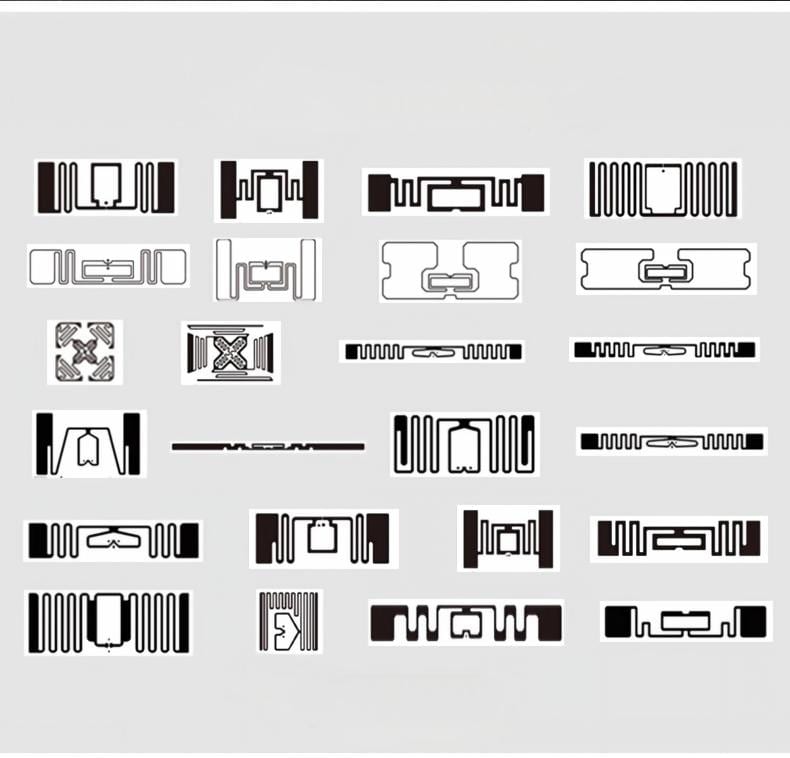
Three technologies, three answers to "where is it". RFID says which zone, BLE says roughly where in the building, UWB says which square metre. Putting all three in one system is a design decision that either simplifies operations or creates a permanent argument about which number is right.
Three technologies, three different jobs
Start by refusing to compare them as alternatives.
- RFID identifies an item and, through read points, implies a zone.
- BLE beacons give a coarse position with a battery lifetime measured in years.
- UWB gives centimetre-level position, at the cost of infrastructure and power.
- RFID tags are passive and cheap; BLE and UWB tags are active and cost real money per unit.
- The right question is which decision each layer has to support, not which technology wins.
Zone, bay and centimetre
Accuracy requirements should be derived from the workflow, not from the datasheet.
- A dock door decision needs a zone: on the truck or in the building.
- A picking decision needs a bay or a shelf, which is metre-level.
- A collision-avoidance or docking decision needs centimetres and low latency.
- Most warehouse decisions are satisfied by zone and bay, which is why RFID covers more than people expect.
- Buying centimetres where nobody needs them creates cost, maintenance and a misleading sense of precision.
RFID gives identity, not position
Its strength is the pairing of a unique identifier with a chokepoint.
- A read at a portal is a strong statement that a specific item passed a specific place.
- Read points can be arranged into a logical graph: door, aisle end, staging lane.
- Position is inferred from that graph, and the inference is only as good as the coverage.
- RFID does not interpolate; between two portals, the item is anywhere.
- Do not ask RFID for continuous tracking; ask it for events at decision points.
UWB gives position, not identity
The tag tells you where something is, but not reliably what it is.
- UWB accuracy is good, and anchors need power, cabling and surveying.
- In dense metal environments, reflections still distort position, and multipath is not free of charge.
- Tag identity is only as trustworthy as the tag assignment process behind it.
- UWB tags need charging or battery replacement, which is a maintenance programme, not a feature.
- Without a clean identity binding to the business object, precise positions describe anonymous blips.
BLE beacons: cheap, coarse, battery-bound
BLE is the layer that survives when budgets tighten, and it shows.
- Beacon density drives accuracy more than beacon quality does.
- Received signal strength is heavily affected by bodies, racking and doors.
- Battery replacement across hundreds of beacons is the real operating cost, not the hardware.
- BLE is excellent for presence in a room or a zone, and poor for metres.
- Beacon firmware and rotation policies matter, because beacon identifiers can be spoofed.
Fuse the decisions, not the sensors
A fusion layer that outputs coordinates is usually the wrong layer.
- Model a decision service: "which zone is this asset in, with what confidence".
- Take RFID events as high-confidence, low-frequency evidence.
- Take UWB positions as low-latency, noisier evidence.
- Take BLE presence as coarse, slow evidence that prevents zone flapping.
- Resolve conflicts with explicit rules and record which source won, because that log is the debugging tool.
Handover between zones and the ambiguity band
Boundaries are where systems embarrass themselves.
- Define zones with a hysteresis band, so an asset sitting on a boundary does not oscillate.
- Set a minimum dwell time before changing a zone assignment.
- Give UWB a higher weight inside a zone and RFID a higher weight at the boundary crossing.
- Handle the case where the asset is genuinely between zones and neither answer is satisfying.
- Expose the confidence, so a downstream process can decide to ask a human.
Calibration, drift and anchor surveying
Position systems decay quietly, and the decay is not visible in a dashboard.
- Survey anchor coordinates once, then re-survey after any racking change.
- Log anchor health, including packet loss and power, as a first-class metric.
- Recalibrate BLE reference points seasonally, since building layout and stock density change.
- Compare fused output against a known reference path monthly, not annually.
- Treat a silent degradation as more dangerous than an outage.
Infrastructure and cost trade-offs
The total cost is dominated by things that are not the tags.
- UWB anchors need network, power and installation labour, which often exceeds the hardware cost.
- BLE beacons are cheap but need a replacement programme and a database of their placements.
- RFID read points need cabling, mounting and periodic read-rate verification.
- Adding a third technology multiplies the integration surface, not just the coverage.
- Model five-year cost including maintenance labour, because that is where the surprises live.
Latency, sampling and the real-time claim
"Real time" is a requirement nobody writes down precisely, and everybody argues about later.
- RFID events arrive in milliseconds at the portal, but only when the item passes the portal.
- UWB updates at a fixed rate, and that rate bounds how fast any decision can react.
- BLE presence is slow by nature and unsuitable for anything time-critical.
- Downstream systems should state their latency requirement, not only their accuracy requirement.
- Measure end-to-end latency from physical movement to a recorded decision, not from reader to server.
Designing the accuracy you actually need
Then buy the cheapest technology that reaches it.
- List the decisions the system must support, and the accuracy each one requires.
- Sort by decision value, not by technical elegance.
- Implement zone logic on RFID first, and measure how many decisions remain unsatisfied.
- Add BLE only where presence in a room is genuinely the missing information.
- Add UWB only where the remaining decisions are worth centimetres and the operating cost of active tags.