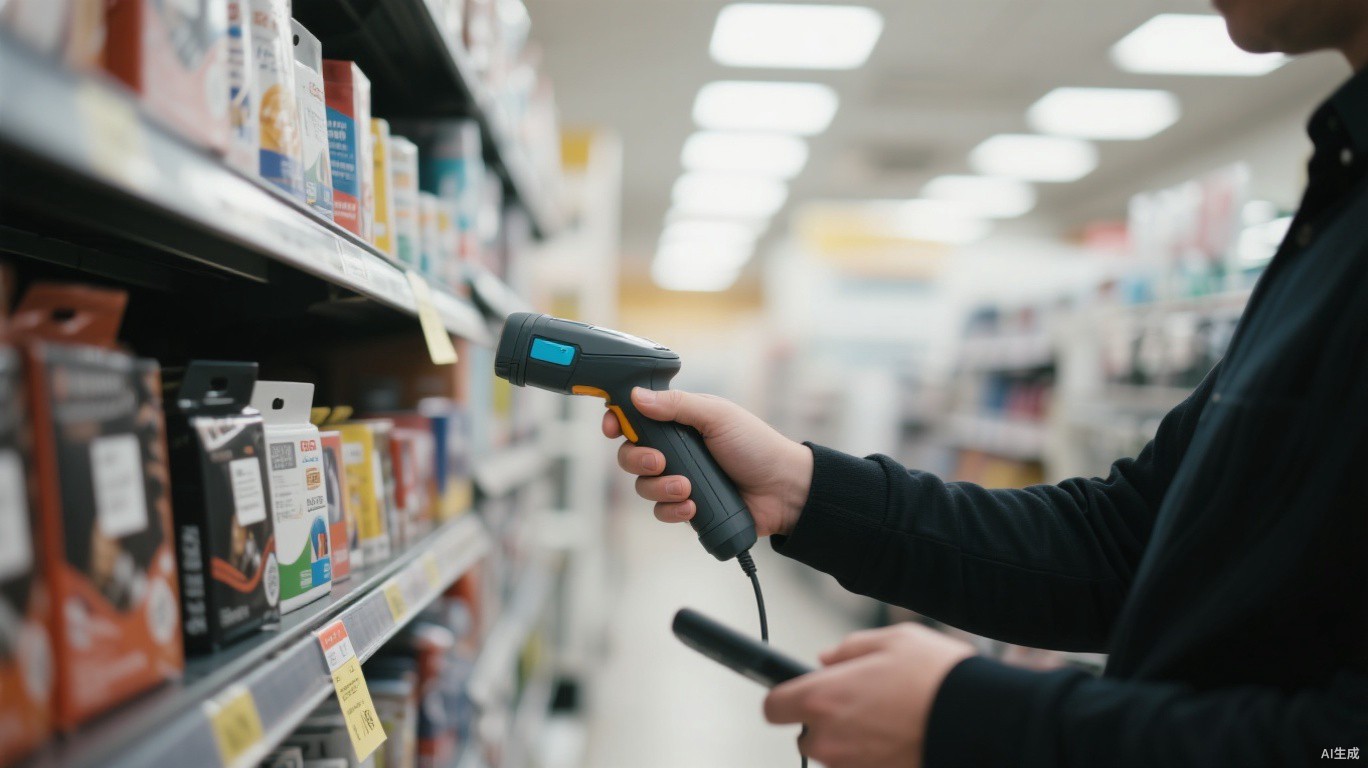
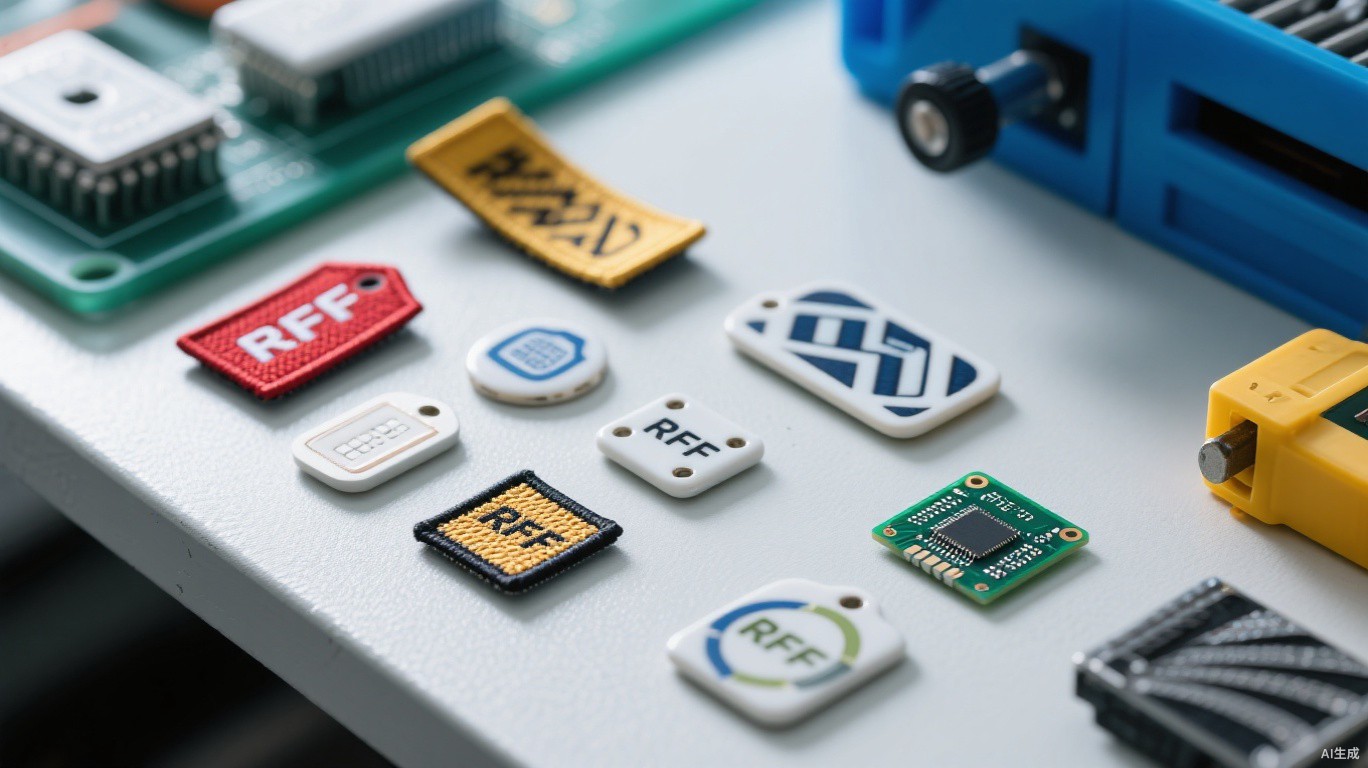
Every few years a new wireless generation is announced and the RFID industry is told that everything is about to change. 4G did not change it and 5G did not either, because neither addressed the two constraints that actually bind RFID: the energy a reader may legally radiate, and the geometry of a metal-filled room.
6G may be different, but not in the way the headlines suggest. Its candidate technologies do not make passive tags faster; they give the infrastructure control over where radio energy goes. That is a narrower promise, and a more useful one.
Three orders of magnitude apart
The first thing to fix in any 6G-RFID discussion is the band chart, because most confusion comes from ignoring it.
- UHF RFID works between roughly 860 and 960 MHz, with a wavelength near 33 centimetres.
- The 6G terahertz candidates begin at 100 GHz and extend towards 1 THz, with wavelengths of millimetres to fractions of a millimetre.
- That is a factor of a hundred in frequency and a factor of ten thousand in free-space loss for the same distance.
- UHF answers the question "which item is this, within a few metres", cheaply and passively.
- Terahertz answers the question "what is the shape, material and exact position of this surface", at short range and higher cost.
What 6G actually contributes
Three mechanisms matter to a tag system, and they matter for different reasons.
- Reconfigurable intelligent surfaces are passive panels that impose a phase profile on incoming waves, turning a wall into a controllable reflector.
- Ultra-massive MIMO gives the reader hundreds or thousands of elements, so the beam can be steered and nulled spatially rather than broadcast.
- Terahertz bandwidth enables fine time resolution, which is what range accuracy is ultimately made of.
- Edge computing and network slicing change how reader infrastructure is deployed and billed, not what a tag can do.
- None of these lowers the price of an inlay, which remains the dominant deployment constraint.
Terahertz RFID and the physics that will not negotiate
Terahertz is attractive on paper because bandwidth is abundant and wavelengths are small enough for tiny antennas. The link budget is where the enthusiasm meets arithmetic.
- Free-space path loss grows with the square of frequency, so 100 GHz costs roughly 40 dB more than 900 MHz at the same distance.
- A passive tag must be powered by the reader, and terahertz offers very little power to deliver over any useful distance.
- Water, and therefore hands and bodies, absorbs strongly at these frequencies; a palm over a tag is a link-budget event.
- Practical deployments will be short range and line of sight: a doorway, a conveyor, a shelf-edge scanner.
- Hybrid designs are more likely than a single band: UHF for identity, terahertz for material or precise position.
RIS and the end of the dead zone
Dead zones are usually geometry, not power. A shelf blocks, a metal rack cancels, a pallet absorbs, and the answer is rarely "turn up the transmitter".
- Multipath cancellation is the dominant cause of a missed read in a dense aisle, not insufficient transmit power.
- An intelligent surface converts an unusable reflection into a controlled one, restoring a path that geometry removed.
- In a warehouse, one surface per aisle can homogenise coverage that would otherwise need three readers.
- The hidden cost is control: the surface must know where to steer, when, and on whose behalf.
- The near-term benefit is fewer readers and lower power per reader, not a dramatic increase in range.
Positioning: from zone to centimetre
Positioning claims in RFID are usually zone-level dressed up as coordinates. 6G changes what is physically possible, and also what is honest.
- Phase-based UHF systems already reach tens of centimetres, at a cost and with careful calibration.
- Terahertz ranging is fundamentally finer because time resolution follows bandwidth, not because the algorithm is cleverer.
- Dense multipath is the enemy of every ranging method, so an intelligent surface helps by removing the worst paths.
- Every accuracy figure must name the environment; a laboratory corridor is not an aisle full of pallets.
- The business question is usually "is it in the right bin", which needs thirty centimetres, not three millimetres.
Energy: the ceiling nobody wants to discuss
Passive tags are limited by regulation and physics, and neither is likely to move much by 2030.
- The reader's effective radiated power is capped by law at around two watts in most jurisdictions.
- Backscatter conversion efficiency declines with frequency, so a terahertz tag would harvest far less than a UHF one.
- Ambient harvesting indoors yields microwatts, which is enough for a sensor occasionally and not enough for continuous streaming.
- Battery-assisted tags solve the energy problem by relocating it to a battery, with the maintenance cost that implies.
- The realistic gains are in antenna efficiency, wake-up protocols and duty cycling rather than in a new band.
What will not change by 2030
The useful part of a forecast is the list of things that stay the same.
- Regulation moves slower than research; the UHF bands will still carry the majority of item-level tagging.
- Tag cost will still decide deployments, and a new band does not make an inlay cheaper.
- The ERP integration problem is a data problem, and no radio generation touches it.
- Store and warehouse procedures will still determine success; bandwidth does not fix a misplaced item.
- Standards will lag, so expect proprietary terahertz sensing first and interoperability later.
A roadmap for practitioners, not researchers
The correct response to a future technology is to build the parts that survive it.
- Do not wait. Deploy UHF now, and make the data model independent of the radio that produced it.
- Buy readers with open interfaces, so that a future sensing layer can be attached without rewriting the integration.
- Keep the location model coarse and consistent; adding a centimetre layer later is easier than correcting a wrong zone.
- Run a terahertz sensing pilot only where the business question is already precise, and treat it as instrumentation.
- Treat 6G as an infrastructure budget line from 2028 onward, not as a reason to delay a 2026 deployment.