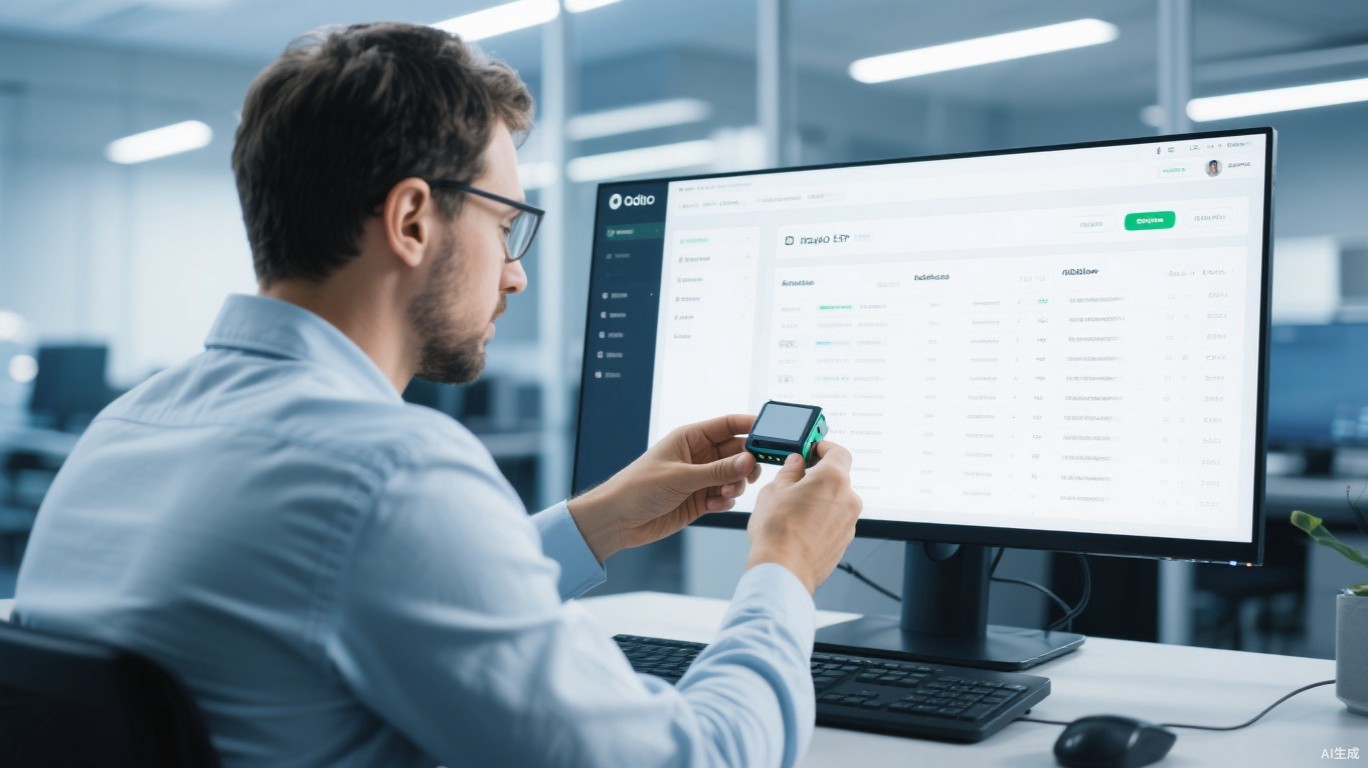
Production reporting looks like a simple automation: the pallet passes a reader, and Odoo updates the work order. It is not simple, because a work order records time as well as quantity, and a read says nothing about when the operation started or who performed it.
A work order is a claim about time, not just quantity
The accounting and the analysis both depend on the time dimension.
- Start and end times drive capacity, lead time and cost per hour.
- A quantity without a duration cannot be used for OEE or for rework analysis.
- A read at the end of the line tells you output; it says nothing about the twenty minutes of waiting in between.
- Reporting the completion of an operation is a separate event from reporting good quantity.
- Design the event model before choosing a read point.
What an RFID read can honestly report
Be strict about the claim each read supports.
- Presence of a specific tote or pallet at a specific point in time.
- Passage through a chokepoint, which is a strong claim if coverage is complete.
- Identity of a batch or serial, if the tag is bound correctly and verified.
- Nothing about operator identity unless the operator carries a tag and a workflow attributes the action.
- Nothing about quality, unless an inspection step writes its own event.
Read points on the production route
Each read point should exist for exactly one decision.
- Entry to the work centre: the operation is starting, and WIP has arrived.
- Exit from the work centre: the operation is complete, and quantity can be booked.
- Buffer and queue positions: know where the item is waiting, which explains the delay.
- Rework loop entry: the item is coming back, so the quantity is not good output.
- Scrap bin: a deliberate disposal event, not a missing read at the exit.
Start, pause, complete: modelling the states
A state machine prevents most reporting arguments.
- Queue, in progress, paused, blocked, done — five states cover most shop floors.
- A pause needs a reason code, or the downtime analysis is decorative.
- Blocked means waiting for material or quality, and is a different cost from idle.
- Transitions must be attributed and timestamped, and must be allowed to arrive late.
- Reject impossible transitions loudly rather than silently repairing them.
Quantity, scrap and the rework loop
Quantities need a source and a moment.
- Good quantity is booked at completion, with the unit of measure of the operation.
- Scrap is booked at the point of detection, with a reason and a work centre.
- Rework is an operation, not a correction; model it as such or the routing will lie.
- Partial completions are normal; allow them and keep the remaining quantity visible.
- Reconcile component consumption separately from output, because they fail differently.
Operator identity and the labour split
Who did the work is a real question in a plant with shifts.
- A badge read at the work centre can open a session, but it does not prove continuous presence.
- Attribute the transaction at the moment of confirmation, not at login.
- Shared work centres need a labour split; a single read cannot invent one.
- Indirect labour is usually missing from automated reporting, and it is usually the interesting part.
- Make manual confirmation easy, or operators will confirm everything at the end of the shift.
Backflushing and the timing trap
Backflushing is convenient and quietly wrong at the edges.
- Backflush consumes components when output is booked, which is fine in steady state.
- On a long operation, backflushing shifts consumption in time and distorts WIP.
- Scrap of components mid-operation is invisible unless the operator reports it.
- Backflush tolerances hide systematic over-consumption until an inventory count finds it.
- For high-value or regulated components, report consumption explicitly, even at a labour cost.
Exception handling when the line stops
The automation has to survive the shift where everything goes wrong.
- A missing read must produce a question, not a silent zero.
- Define who can confirm manually, and require a reason.
- Buffered events must be replayable in order, with the original timestamps preserved.
- A line that runs without the reader must be able to report on paper and reconcile later.
- Track how often manual confirmation is used; it is the health metric of the automation.
Sync model: events, not counters
Odoo's work orders have states; the integration should speak in transitions.
- Send operation events with identifiers, and let Odoo own the resulting quantities.
- Never increment a progress percentage directly; derive it from booked quantities.
- Make ingestion idempotent, because shop floor networks retry.
- Keep the raw event log, so a disputed quantity can be reconstructed.
- Reconcile daily: events received, quantities booked, differences explained.
Serialisation and genealogy
A serial at the end of the line is a promise about components.
- A serial read creates a genealogy claim that has to be defensible in a recall.
- Component lots must be bound to the serial at build time, never reconstructed afterwards.
- A serial reused across units destroys recall analysis and any warranty position.
- Genealogy is only as good as the component reporting upstream; if that is backflushed roughly, the recall list is worthless.
- Printing and applying the serial label is itself an operation, and label errors are a leading cause of genealogy failure.
Metrics and pilot
Prove the reporting is better, not merely more automatic.
- Measure reporting lag, manual confirmation rate, and the share of operations with a real start time.
- Compare OEE figures before and after, and check whether the change is measurement or reality.
- Run a pilot on one work centre with a stable routing and a cooperative shift lead.
- Watch the exception rate in the first month, because it predicts whether the team will keep using it.
- Decide in advance what level of manual fallback is acceptable.