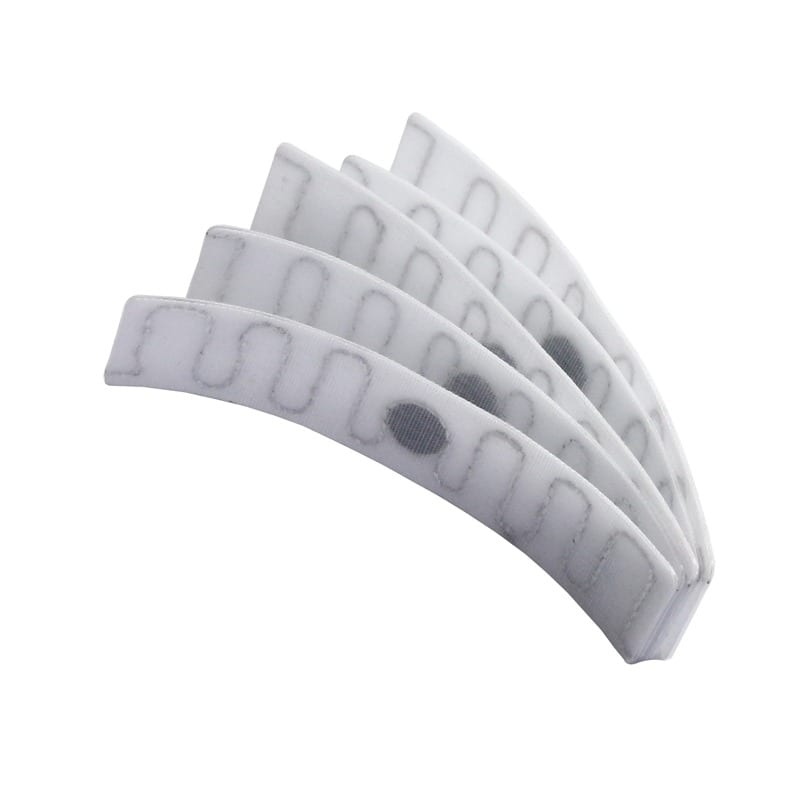
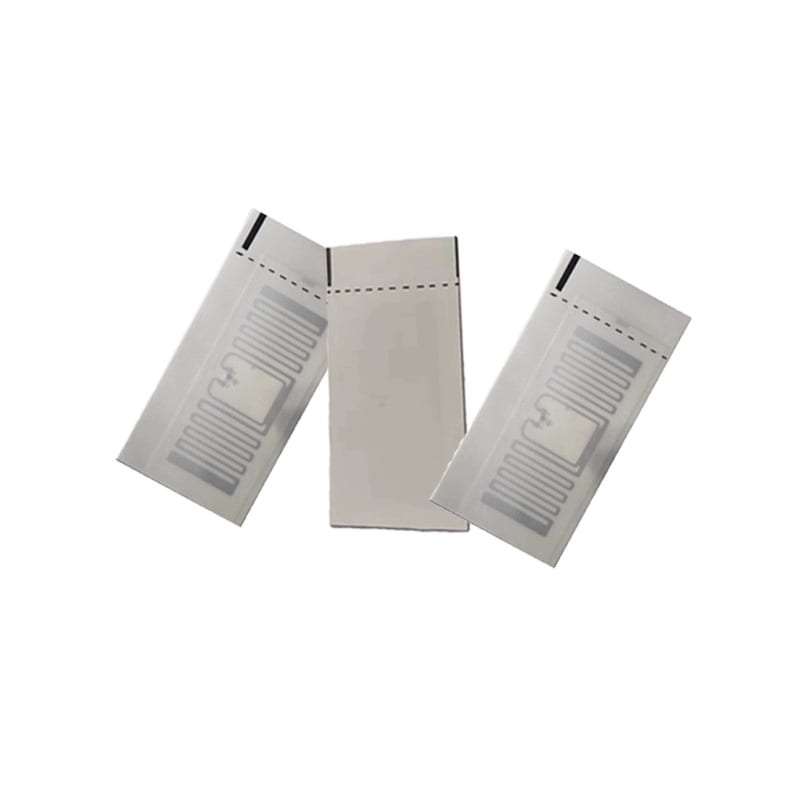
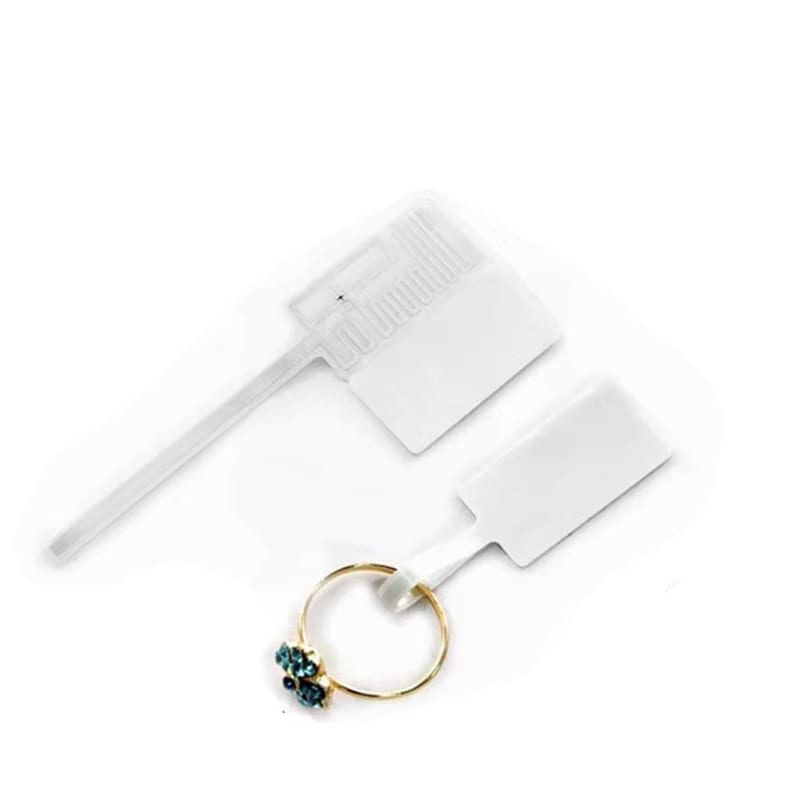
A jewelry chain can hold four thousand SKUs in a store and count them twice a year, because counting by hand takes three people a full day. The business case for RFID here is obvious and the physics is hostile: everything is metal, everything is small, and the tag must not be visible to a customer holding the piece.
Why jewelry is the hardest RFID category
Four constraints apply at once, and each one breaks a standard retail assumption.
- Metal detunes an inlay and shrinks its read range to a few centimetres at best.
- Items are tiny, so the tag must be smaller than the object it identifies.
- Value density is extreme, which makes every missed read an expensive error.
- Aesthetics are part of the product, so a visible label is a commercial defect.
- The showcase is glass with a metal frame, which is a very effective shield.
What a micro ceramic tag changes
A ceramic substrate is not a coating; it is a different physical arrangement.
- Ceramic is dielectric and stable, so the tag does not detune against the metal it sits on.
- Small ceramic tags trade read range for size, typically working best at close range.
- The tag can be embedded in a price tag, a pouch or a display backing, staying invisible.
- Read range measured on a bare table is meaningless; it must be measured on the actual jewelry.
- Cost per tag is higher than a paper label, and the value per item justifies it.
Placement: the two centimetre problem
Placement rules for jewelry are stricter than for any other retail category.
- Distance from metal is the dominant variable; two millimetres of separation can double read range.
- Place the tag away from the clasp and the dense part of the piece, where the metal mass is largest.
- Never place two tags face to face; in a tray they will shadow each other.
- Orientation should follow the reader antenna, and in a showcase that means vertical.
- Test every product family, because a ring, a chain and a watch behave differently.
Showcase and drawer read zones
A jewelry counter is a shielded box with a hinge, and it must be treated as an antenna problem.
- A shelf antenna under the pad reads items above it, and the glass lid does not hurt if the frame is away from the field.
- Side-mounted antennas suit vertical displays and necklace busts.
- Trays that stack must be counted one level at a time, or lower levels never read.
- Metal drawer dividers partition the field, which can be useful or catastrophic depending on layout.
- Commission each showcase individually; a design that works for rings may fail for watches.
The count process staff will follow
A count that takes a day will be done twice a year; a count that takes ten minutes will be done weekly.
- Open the drawer, press once, read the count, compare with the expected number on screen.
- Exceptions must be visible instantly: items expected but not found, items found but not expected.
- The count should be possible with one hand while the other holds the tray.
- Do not require a laptop, a login or a wired connection in the middle of the sales floor.
- Print or display the variance list, so the salesperson can look for the missing piece immediately.
Loss prevention without false alarms
Jewelry RFID is usually sold as inventory first and security second, and the order matters.
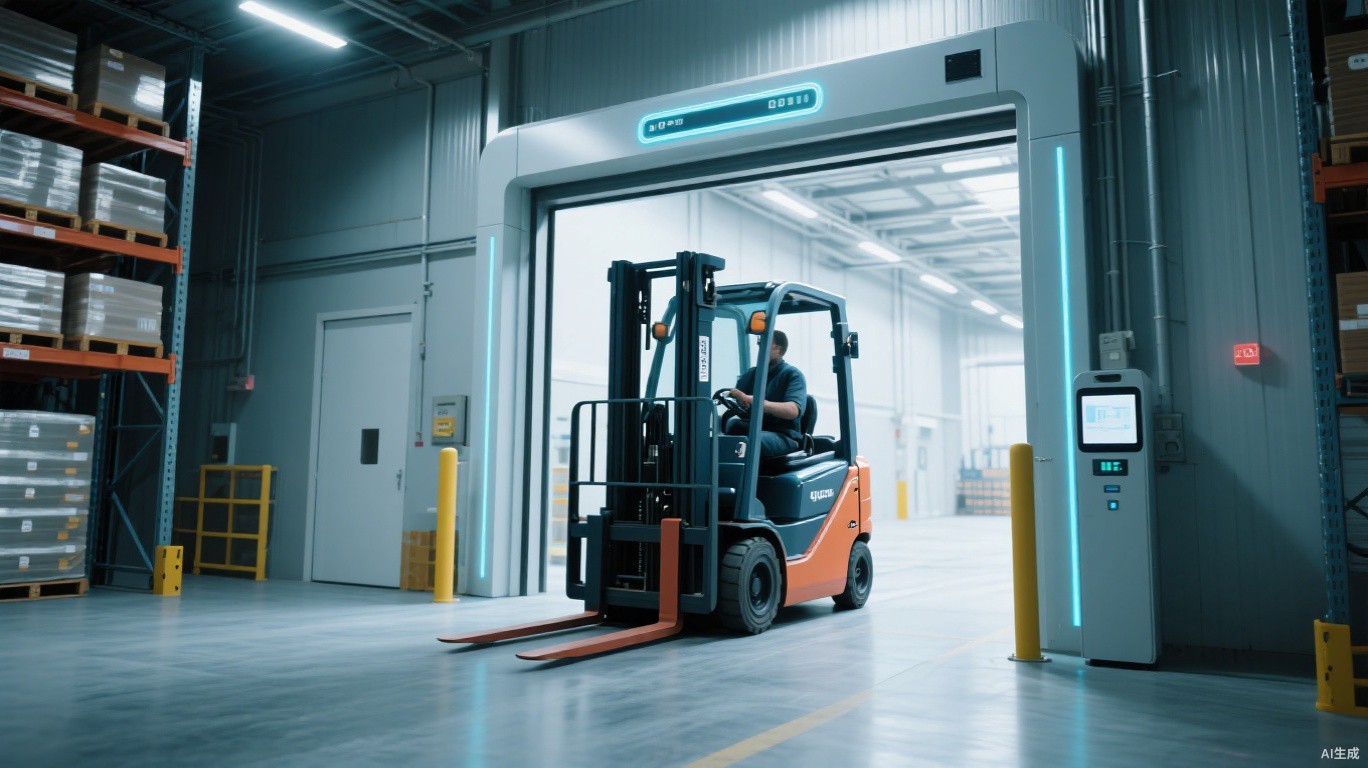
- A portal at the door catches tagged items leaving without a sale, but a busy entrance produces noise.
- Combine the exit read with the POS transaction, so a sold item leaving is not an alarm.
- Keep the alarm threshold tunable per store, because fixture density differs.
- Security benefit is real but secondary; the primary return is inventory accuracy and staff time.
- Never make staff dependent on the alarm alone; it is a signal, not a gate.
Integration with the retail system
The tag is only useful if the store system knows what it means.
- Bind the tag identifier to the SKU and the unique piece at receiving, not at the counter.
- For one-of-a-kind pieces, the tag identifier is the piece identity, so treat it as a serial number.
- Record the count session with a timestamp and a user, so a variance can be investigated.
- Reconcile the store count with the central stock file nightly, and flag items that moved without a transaction.
- Keep the tag identifier stable across repairs and returns, or history is lost.
Economics and the honest limits
Micro ceramic tags are not a universal solution, and pretending they are wastes the budget.
- Expect a working read zone of a few centimetres to a few tens of centimetres, not metres.
- A full-store walkthrough inventory is not realistic; the model is count-by-fixture.
- High-value single pieces benefit most; low-value fashion jewelry often does not justify the tag.
- Tag cost matters at the low end of the assortment, so segment the range before committing.
- The gain is staff hours and accuracy, and those are measurable in the first quarter.
Judged on that basis, micro ceramic tags do something rare in retail technology: they make a process that nobody wanted to do into one that takes ten minutes, and they do it without changing how the product looks.
Receiving and tagging: where the programme is won
A store-level RFID programme is decided in the back room, months before a customer sees a count on a screen.
- Tag at receiving, when the piece is in a controlled environment and the paperwork is still open; tagging at the counter competes with selling.
- Apply the tag to the backing or the pouch, never to the metal, and verify the read on a fixed desk reader before the piece goes into a tray.
- Record the tag-to-piece binding in one transaction; re-keying it later is a data error waiting to be discovered.
- Test the first hundred pieces of a new supplier's packaging, because pouches and boxes change the separation from metal.
- Audit a random sample monthly: ten pieces, read them, confirm they match the expected file, and log the result.
- Confirm the identifier stays readable after the piece has sat in a tray for a shift, because heat and pressure do their own work.
With that discipline, the store count becomes a ten-minute routine and the annual panic quietly disappears.