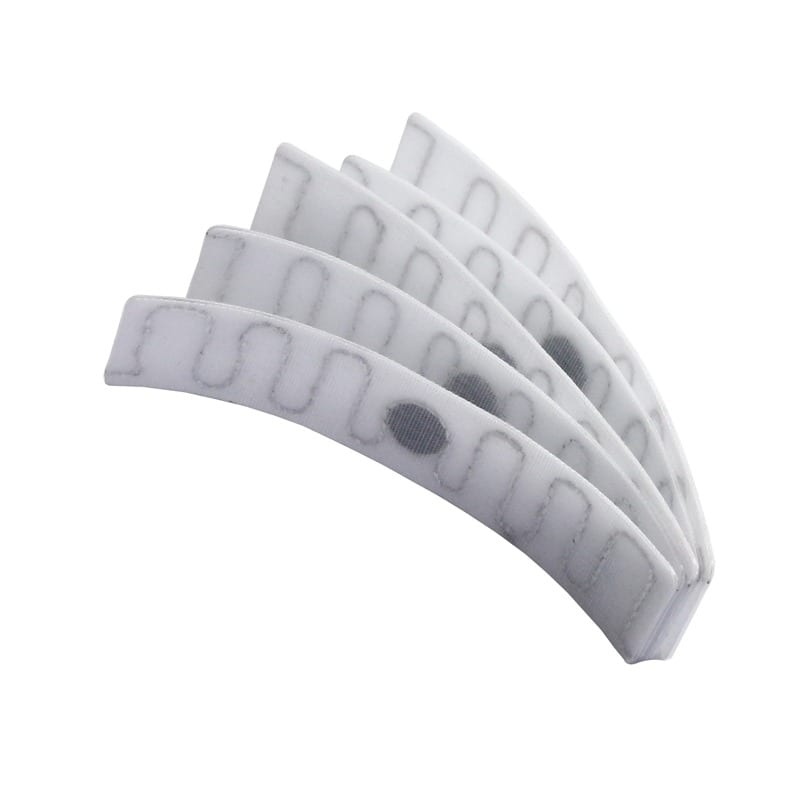
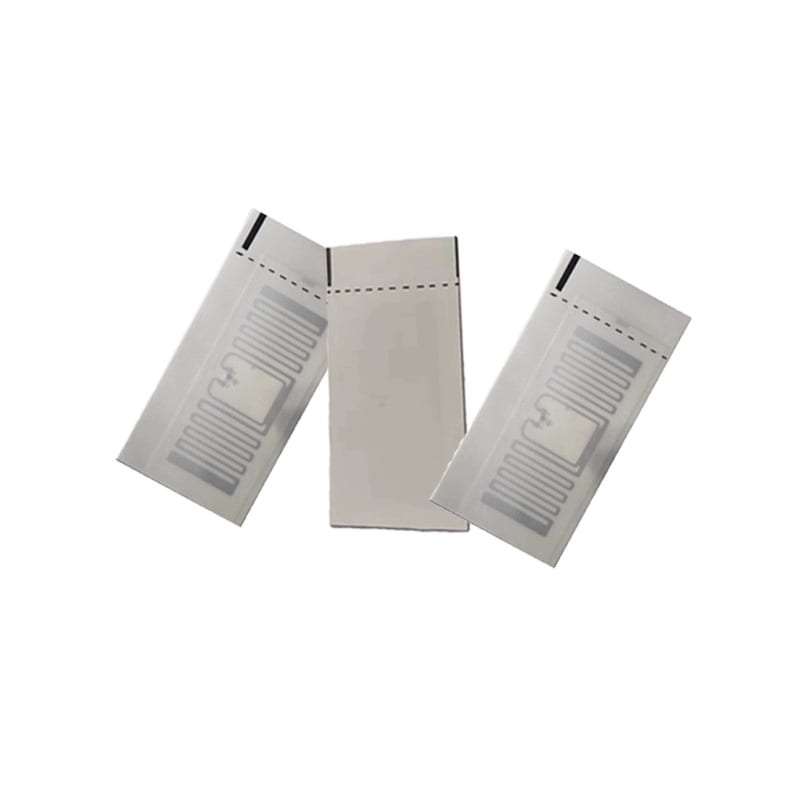
A woven label is the most elegant place to hide an RFID inlay in apparel. It is also the most abused: washed, dried, tunnelled, pressed and folded for the life of the garment. The question is not whether the label survives one test, but whether it survives the sequence a real customer or a real laundry will apply.
What a woven label has to survive
Wash durability is a sequence, not a single event.
- Water and detergent, at temperatures from cold to near boiling depending on the programme.
- Mechanical action: drum rotation, tumbling, and friction against other garments.
- Thermal shock: a hot wash followed by a cold rinse, repeated.
- Drying: tumble drying at high heat is often harsher than the wash itself.
- Finishing: pressing, steaming and ironing, which apply both heat and pressure.
- Industrial laundry adds chemical dosing, high throughput and much shorter cycles per garment.
Domestic versus industrial, honestly
The gap between the two is bigger than most specifications admit.
- A domestic programme might apply 40 cycles in the life of a garment; an industrial laundry may run 100 in a few months.
- Industrial chemistry is stronger: bleaches, sours and softeners at controlled concentration.
- Tunnel washers apply mechanical action differently from a drum machine, which changes where abrasion hits.
- Industrial drying and ironing lines run hotter, and dwell times are longer.
- A tag that passes 50 domestic cycles is not implicitly approved for a rental laundry contract.
The failure mechanisms
Understanding how a woven label dies explains why the test must be designed carefully.
- Antenna breakage from repeated flexing, because the metal is thin and the fabric moves.
- Chip detachment at the strap, which is the most common cause of a silent failure.
- Moisture ingress degrading the adhesive that holds the inlay inside the weave.
- Detuning from absorbed water, which shows up as reduced read range rather than no read.
- Abrasion of the label surface, which matters for print durability more than for the chip.
Designing a test that means something
A wash test with one label and one cycle proves nothing.
- Use at least 30 labels per cell, from at least two production lots.
- Test domestic and industrial separately, and label the results accordingly.
- Include the full cycle: wash, rinse, dry, and where relevant press or iron.
- Measure read rate before the first wash and after every ten cycles, not only at the end.
- Record the read range, not just pass or fail; a tag that reads only at two centimetres has effectively failed.
- Keep control samples aside, unwashed, to separate manufacturing defects from wash damage.
What the numbers usually look like
Real programmes see a curve, not a cliff, and the shape matters.
- Most failures appear in the first ten cycles, which is where manufacturing defects surface.
- A second, slower decline follows as moisture and flexing accumulate.
- Read range usually degrades before read rate does, so range is the earlier warning.
- Industrial cycles typically reach the same damage level in a fifth of the domestic cycles.
- Labels that survive a hundred industrial cycles exist, and they are specified and priced accordingly.
Choosing a label that can pass
The label construction decides the result before the test begins.
- Inlay position inside the weave matters: near the fold line, flexing is concentrated and failure comes early.
- Softer substrates distribute mechanical stress better than stiff ones.
- Encapsulation quality, not label thickness, is what keeps moisture out of the strap.
- A larger antenna tolerates detuning better than a small one, because it starts with more margin.
- Ask the supplier for the wash test protocol, not only for the claim; a claim without a protocol is marketing.
Where to place the label on the garment
Placement is a design decision with a measurable effect.
- Avoid the side seam near the hem, where abrasion against the drum is highest.
- Avoid the area behind a zip or a button, where pressure concentrates during pressing.
- The centre-back neck label is exposed to fewer mechanical cycles than a hem label.
- For rental garments, ask the laundry operator where wear concentrates, and avoid it.
- Test the placement, not only the label; the same label at two positions can differ by a generation.
Reading after washing
A washed label needs a reader configured for a weaker tag.
- Expect detuning after the first wash; a tag that read at 60 centimetres may read at 30.
- Use the reader and antenna you will deploy, not a lab reader with optimal settings.
- Measure the read time per item, because a slow read is a failed read at a checkout with a queue.
- Test a whole bundle of washed garments, because tags shadow each other differently once the fabric is damp or stiff.
- Re-test after a month of storage, because some failures appear only after the moisture redistributes.
When a batch fails the test
A failed batch is data, not a dead end, if you can localise the failure.
- Compare washed and unwashed samples from the same lot first; if both fail, the problem is manufacturing, not washing.
- Map where the failures sit on the garment; a cluster near a seam points to placement rather than to the label.
- Read a failed tag in the hand at close range; if it reads at two centimetres, the antenna is intact and the chip is marginal.
- Ask the supplier for the inlay lot and the encapsulation batch, because one bad batch is common and cheap to replace.
- Re-run ten cycles on the replacement lot before releasing it, and keep the failed samples for the claim.
Writing the specification
A purchase specification is what protects you when a batch underperforms.
- State the number of cycles, the programme and the chemistry, not just the word "washable".
- State the acceptable read rate and the minimum read range after the stated cycles.
- Require lot-level test reports, and a sample retention period long enough to investigate a claim.
- Define the failure criteria in physical terms: no read, read below range, or unreadable at the till.
- Re-qualify when the label construction, the inlay or the adhesive changes, because "same part number" is not a guarantee.
Written and tested this way, a woven label stops being a hopeful accessory and becomes a component with a defined life, which is exactly what an apparel RFID programme needs in order to promise a customer anything.