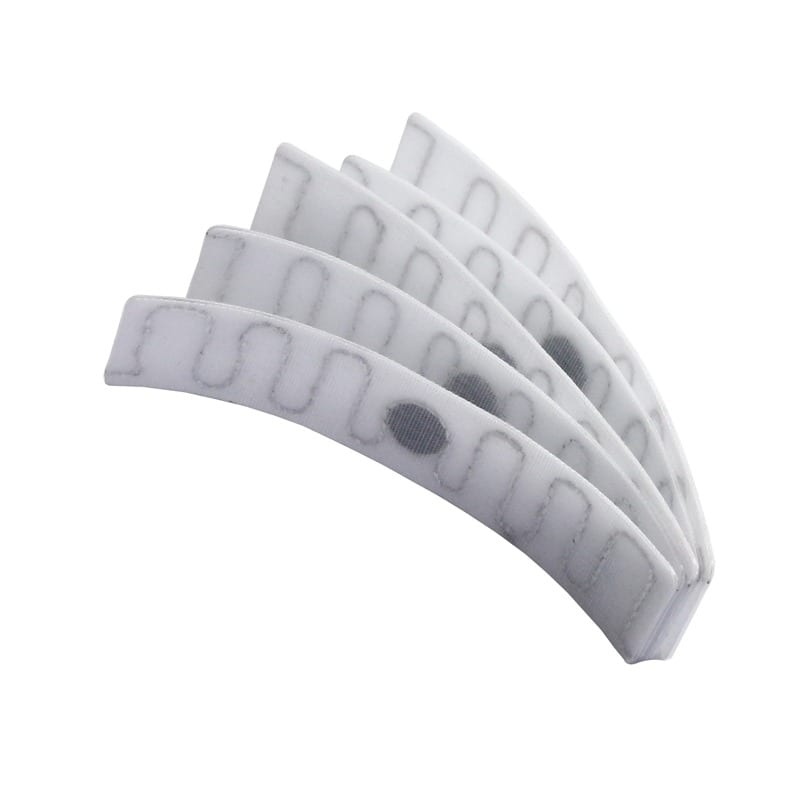
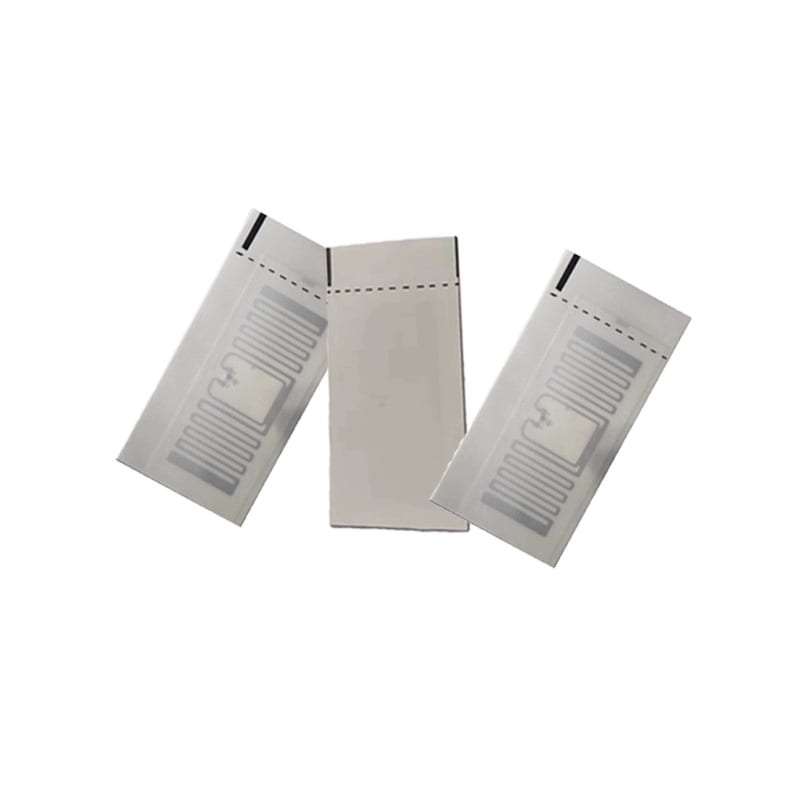
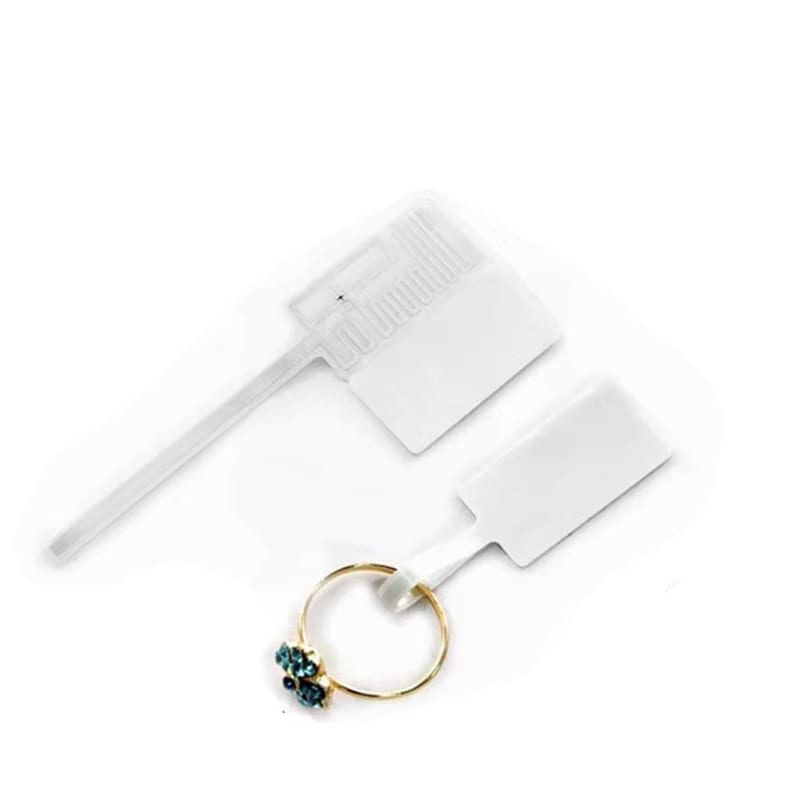
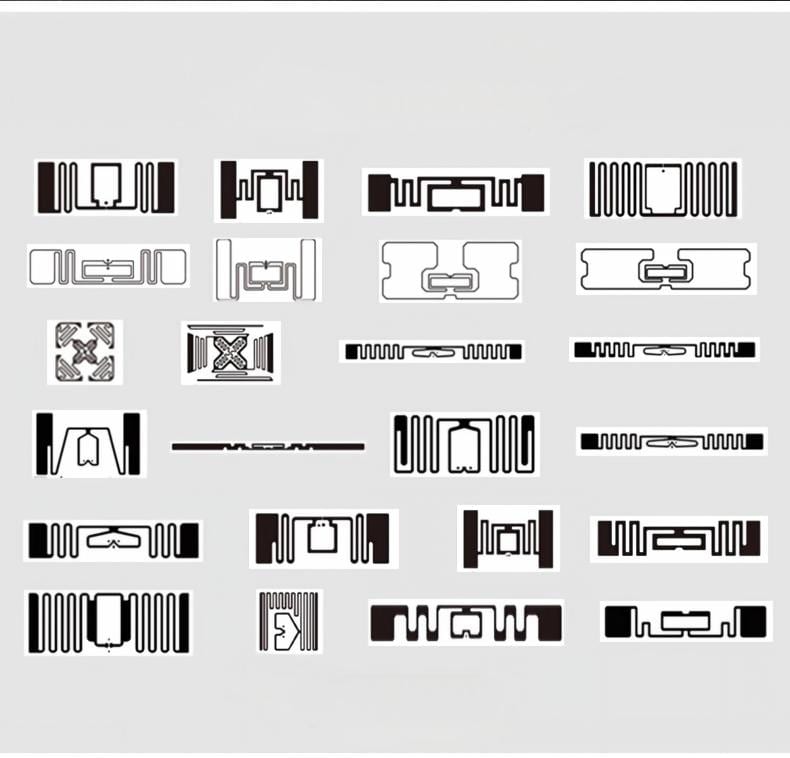
Put a standard UHF inlay on a steel plate and the read distance collapses to zero. This is not a weak tag; it is a tag whose antenna has been shorted by physics. Every anti-metal product on the market is an answer to that short, and the answers differ in ways that matter.
The useful way to think about it is impedance engineering. A tag is a resonant circuit coupled to a wave, and metal changes both the wave and the circuit. Ferrite is one way to restore the coupling. It is not the only way, and it is not always the best.
Why metal destroys a UHF tag
The failure is total and it happens in two places at once.
- A metal surface reflects the incident wave almost perfectly, with a phase inversion of 180 degrees.
- The reflected wave and the incident wave cancel at the antenna, driving induced voltage towards zero.
- The metal also shifts the antenna's input impedance, moving it away from the conjugate match the chip needs.
- Both effects grow as the tag gets closer, which is why "almost touching" is worse than "a few millimetres away".
- The result is not a reduced range; it is a tag that a reader can see only from a few centimetres, if at all.
The spacer effect: distance alone helps
Before buying a special tag, understand how much a simple air gap already buys.
- Moving a standard inlay five millimetres off the metal often restores a metre or more of range.
- The gap reduces both the image current and the impedance detuning, though it does not eliminate them.
- Foam, plastic or a thick adhesive can serve as the gap, which is why some "anti-metal" products are simply well-spaced standard inlays.
- A gap filled with the wrong dielectric can be worse than air; water-absorbing foam is a common culprit.
- The practical limit is mechanical: a five-millimetre bump on a curved pipe is a damage risk.
What ferrite actually does
Ferrite is a magnetic material, and its role is to change where the electromagnetic field is allowed to go.
- High permeability at UHF frequencies gives the magnetic field a low-reluctance path through the ferrite rather than into the metal.
- That reshapes the near field so the antenna sees a boundary closer to free space than to a conductor.
- It also acts as a physical spacer with a controlled dielectric, which is why ferrite thickness and adhesive thickness are specified together.
- Ferrite is lossy if the grade is wrong; the material has to be selected for the band, not for its magnetic strength.
- The tag antenna on top is usually redesigned for the new boundary, so a ferrite sheet under a standard inlay is not a guaranteed fix.
The numbers that matter on a datasheet
Anti-metal datasheets are full of figures that are measured in conditions you will never reproduce.
- Read distance is usually quoted with a two-watt handheld at optimum angle, on a large flat steel plate.
- Expect thirty to sixty percent of the free-space range of an equivalent non-metal tag, not parity.
- Thickness matters in both directions: too thin restores little, too thick lifts the tag off the surface and invites mechanical damage.
- Operating temperature and adhesive type decide whether the tag survives a year, and they are rarely in the headline specification.
- Reusability is a separate product: a tag that can be removed and reapplied is usually a different construction, not the same one with stronger glue.
A selection matrix by metal geometry
The tag follows the geometry, not the material name.
- Large flat steel: a rigid ferrite-backed label with a full backing sheet works well and is the easiest case.
- Curved pipe or cylinder: a flexible ferrite sheet or a curved bracket; a rigid label will peel at the edges.
- Thin metal foil or metallised film: still a conductor, so treat it as metal; thin does not mean transparent.
- Mesh, perforated or expanded metal: partially transparent at UHF, so test rather than assume, and expect angle dependence.
- Metal inside a plastic housing: the plastic is irrelevant; the tag must be spaced from the metal inside.
Read distance in practice
Field numbers are more useful than catalogue numbers, and they are consistent across vendors.
- A ceramic on-metal tag on a steel plate typically reads one to three metres with a fixed reader at two watts.
- The same tag on a curved surface loses twenty to forty percent of that range, depending on curvature.
- Read angle matters more than on dielectric surfaces, because the ground plane narrows the usable pattern.
- Stacked metal items shadow each other; a tag on the outer surface of a stack is not a tag on every item.
- Handheld reads are shorter than fixed-reader reads, so the pilot must use the device the operators will actually carry.
Failure modes worth designing around
Most anti-metal deployments fail for mechanical or procedural reasons, not electromagnetic ones.
- Edge peeling on curved surfaces is the most common field failure, and it usually ends as a lost tag rather than a weak one.
- Re-painting or powder coating after tagging detunes the antenna and hides the label under a conductive layer.
- Cleaning chemicals attack the adhesive; a tag that survives the radio test can still fall off in a wash-down area.
- Mixed loads of metal and plastic confuse a single tag choice; often the honest answer is two tag types and a rule.
- Metal racks act as a large ground plane, so a tag on a rack reads differently from the same tag on a shelf inside it.
A specification checklist
The checklist is short because the failure modes are known.
- Test on the actual object, at the actual mounting position, with the actual reader and antenna.
- Specify the gap or ferrite thickness in millimetres, and specify the adhesive chemistry, not just "strong".
- Ask for the read distance at the angle the installation will use, not the best-case angle.
- Check the temperature range against the process the asset goes through, including cleaning and drying.
- Agree an inspection interval for peeling and a replacement policy, because anti-metal tags fail mechanically first.